| 🎵 Song Information | |
|---|---|
| Song Name | Papaoutai |
| Singer | Paul Van Haver, CUT_ |
| Album | Papaoutai |
| Music Director | Paul Van Haver |
| Lyricist | Paul Van Haver |
| Video Director | Andreas Stillman |
| Label | CUT_ - Topic |
| Release Date | May 16, 2014 |
| Songwriter | Paul Van Haver |

At first glance, “Papaoutai” sounds like a fun, upbeat dance track. But if you speak French, you know it is actually one of the saddest songs ever to top the charts.
Released by the Belgian maestro Stromae from his masterpiece album Racine Carrée, the title “Papaoutai” is a clever play on words. It sounds like the African name of a dance, but it is actually a slurred pronunciation of the French phrase: “Papa, où t’es?” (Dad, where are you?).
The song is autobiographical. Stromae’s own father was an architect who was killed during the 1994 Rwandan genocide. The song explores the pain of growing up with an absent father.
🎵 The Chorus: The Cry for Help
“Où t’es, papaoutai? / Où t’es, papaoutai?”
(Where are you, dad? / Where are you, dad?)
Meaning: The repetition mimics a child asking the same question over and over, hoping for a different answer. The upbeat music represents the “mask” the child wears to hide their pain from the world.
🧩 Verse 1: The Lies Adults Tell
“Dites-moi d’où il vient / Enfin je saurai où je vais”
(Tell me where he comes from / Finally I’ll know where I’m going)
Meaning: This touches on a deep psychological truth: It is hard to know your own identity (“where I’m going”) if you don’t know your roots (“where he comes from”).
“Maman dit que lorsqu’on cherche bien / On finit toujours par trouver”
(Mom says that when you look hard enough / You always end up finding what you look for)
Meaning: His mother tries to give him hope, but the child is cynical. He replies sarcastically that while she says you can find anything, “he” (the dad) is never found.
🎭 Verse 2: The Cycle of Abandonment
“Un jour ou l’autre on sera tous papas / Et d’un jour à l’autre on aura disparu”
(One day or another we will all be dads / And from one day to the other, we will have disappeared)
Meaning: This is the darkest line. Stromae fears that abandonment is a cycle. He worries that becoming a father inevitably means becoming absent, because he never had a role model to teach him otherwise.
“Papaoutai” is not just a song; it is a heartbreaking question wrapped in a dance beat. Stromae wrote this song about his own father, who was killed in the 1994 Rwandan genocide. The lyrics explore the confusion, anger, and fear of a young boy growing up without a male role model.
Below is the detailed breakdown of the lyrics.
Stromae – Papaoutai Lyrics
Verse 1: The Innocent Questions
“Tell me where he comes from / At last I’ll know where to go”
“Mommy says that when you look hard / You always find something”
The child believes that if he finds his father (“where he comes from”), he will finally understand his own identity (“where to go”). His mother tries to protect him with vague optimism (“you always find something”), but this only adds to the child’s confusion.
“She says he’s never very far away / He leaves very often for work”
“Mommy says, ‘Working is good’ / Better than being in bad company”
The mother invents excuses (“he’s working”) to hide the painful truth that the father is gone. She tries to frame his absence as a virtue (“working is good”), teaching the child that absence is better than being a “bad influence.”
The Chorus: The Relentless Search
“Where are you? Dad, where are you?”
(Où t’es, papaoutai?)
The title Papaoutai sounds like a word from an exotic language or a dance name, but it is actually a slurred, childish way of saying “Papa, où t’es?” (Dad, where are you?). The repetition mimics a child asking the same question over and over, slowly realizing no answer is coming.
Verse 2: The Fear of Becoming Him
“One day or the other we’ll all be dads / And from one day to the other we’ll disappear”
This is Stromae’s deepest fear. He worries that abandonment is a cycle. Since he never learned how to be a father, he fears that he too will “disappear” when he becomes one.
“Everyone knows how to make babies / But no one knows how to make dads”
This is the most famous line of the song. It highlights the difference between biology and responsibility. “Making a baby” is a simple biological act, but “making a dad” (becoming a father figure) is a skill that must be learned—and Stromae has no teacher.
“Mr. Know-It-All must’ve inherited it, that’s right / Maybe you need to wing it or something?”
He sarcastically refers to “Mr. Know-It-All”—people who claim parenting is natural instinct (“inherited”). Stromae argues that since his father wasn’t there to pass down that instinct, he is forced to just “wing it” (guess) through life.
Full Lyrics:
Tell me where did he come from
Then I’d know where to go
Momma says look really hard
You will always find what you’ve lost
She’s says he’s never far
He goes out and works hard
Momma says working is good
No ungodly company, true?
Untrue?
Where are you papa?
Tell me where papa?
Without having to show to you
I know you know it is no good
Ah damn you papa
Tell me where you hide
Oh, my fingers must’ve counted
Them a thousand times
Outai papaoutai
Outai papaoutai
Outai papaoutai
Outai outai papaoutai
Well, you believe it or not
One day you’ll believe no more
Some day all will be papa.
One day all walk out the door
Will we be despicable?
Will we be admirable?
Passing genes or be genius?
Who takes blame for the irresponsible?
Can you explain
Everyone knows how to make a kid
But no one tries to make a dad
Mister know it all inherits it,
Do we have to make it up ourselves?
Tell us where do you hide?
Sucked our fingers dry
A thousand times
Outai papaoutai
Outai papaoutai
Outai papaoutai
Outai outai papaoutai
Where are you papa?
Tell me where papa?
Without having to show to you
I know you know it is no good
Ah damn you papa
Tell me where you hide
Sucked our fingers dry a thousand times 2x
Outai papaoutai
Outai papaoutai
Outai papaoutai
Outai outai papaoutai
Conclusion
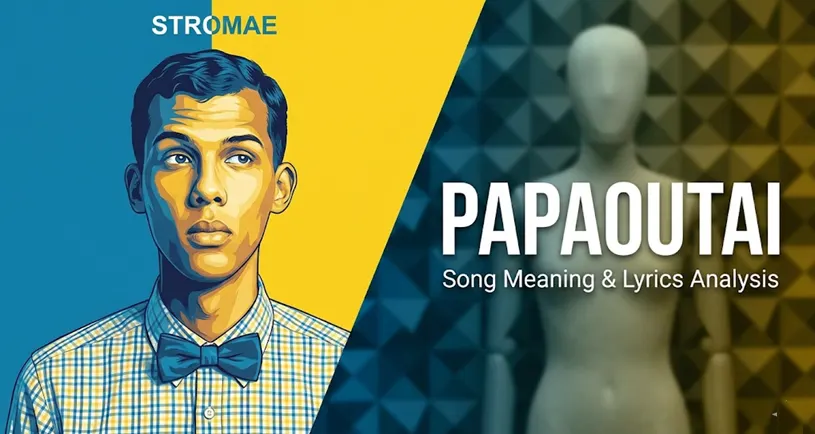
In the music video, Stromae plays a mannequin—a stiff, frozen father who is physically present but emotionally absent. The song ends with the realization that waiting for the perfect father is useless; we must learn to define ourselves without them.
About This Article
| Reviewed By | Music Research Team |
|---|---|
| Content Type | Song Meaning, Translation, Background & Educational Analysis |
| Published | January 22, 2026 |
| Last Updated | January 22, 2026 |
| Reading Time | 5 min read |
| Article Purpose | Provide educational analysis, song meaning, translation, artist information, and verified music facts. |
Sources
This article has been prepared using publicly available music information and reliable editorial references. Song details, artist information, and album metadata have been verified using the following official and trusted sources whenever available.
- Official Artist Website
- Official Record Label
- Spotify
- Apple Music
- YouTube Music
- MusicBrainz
- Discogs
- AllMusic
- IMDb (where applicable)
Copyright Notice
Copyright Disclaimer & DMCA Notice:
Song lyrics are protected by copyright law and are the exclusive property of their respective owners. The lyrics and translations provided on this website are published for educational, commentary, research, and informational purposes only.
Notice to Copyright Holders:If you are a copyright owner or an authorized agent and believe that any content on this website infringes upon your copyrights, please contact us at info@songsubtext.com.
We respect intellectual property rights and will promptly remove any infringing material upon valid request.
Editorial Policy
Our editorial team researches every article using reliable music databases, official artist information, album credits, and trusted industry resources. Every page is reviewed for originality, accuracy, and compliance with copyright regulations.