| 🎵 Song Information | |
|---|---|
| Song Name | Vande Mataram |
| Singer | Lata Mangeshkar, A.R. Rahman |
| Music Director | Jadunath Bhattacharya (Original) |
| Release Date | January 24, 1950 |
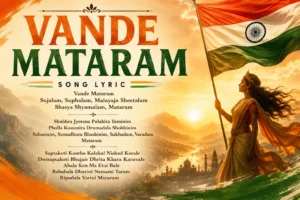
“Vande Mataram” is not just a song; it is the battle cry of India’s freedom struggle. Written by Bankim Chandra Chattopadhyay in 1882 for his novel Anandamath, it was later adopted as the National Song of India.
The lyrics are a mix of Sanskrit and Bengali. The song personifies India as a Mother Goddess—rich, powerful, and nurturing. It describes the beauty of the land, its rivers, fruits, and winds.
Below is the line-by-line meaning of the verses adopted as the National Song.
✅ You May Also Like:
The Chorus: Salutation to the Mother
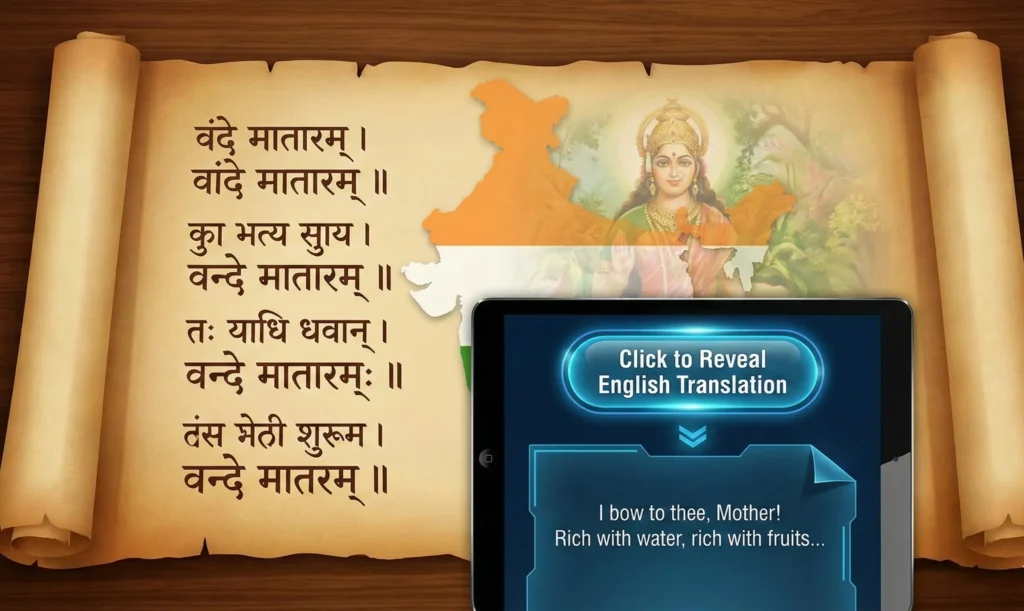
“Vande Mataram”
“Vande Mataram”
“I bow to thee, Mother.”
This simple phrase became the mantra of the Indian Independence Movement. It is a pledge of allegiance and devotion to the Motherland.
Verse 1: The Beauty of the Land
“Sujalam, Suphalam, Malayaja Shitalam”
“Sasya Shyamalam, Mataram”
He describes the land as:
Sujalam: Rich with water (rivers/streams).
Suphalam: Rich with fruits (bountiful nature).
Malayaja Shitalam: Cooled by the sandalwood winds from the south (Malaya mountains).
Sasya Shyamalam: Dark green with the crops of the harvest.
Verse 2: The Glory of the Night
“Shubhrajyotsna Pulakitayaminim”
“Phullakusumita Drumadala Shobhinim”
“Her nights are rejoicing in the glory of the moonlight.”
He describes the land as being adorned with trees and flowering shrubs (“Drumadala Shobhinim”).
“Suhasinim Sumadhura Bhashinim”
“Sukhadam Varadam, Mataram”
“She laughs sweetly, she speaks sweetly.”
The poet calls the Motherland the giver of happiness (“Sukhadam”) and the giver of boons/blessings (“Varadam”).
Conclusion
“Vande Mataram” reminds us that the nation is not just land on a map, but a living, breathing mother figure who sustains us with her water, food, and love.
About This Article
| Reviewed By | Music Research Team |
|---|---|
| Content Type | Song Meaning, Translation, Background & Educational Analysis |
| Published | January 27, 2026 |
| Last Updated | January 27, 2026 |
| Reading Time | 3 min read |
| Article Purpose | Provide educational analysis, song meaning, translation, artist information, and verified music facts. |
Sources
This article has been prepared using publicly available music information and reliable editorial references. Song details, artist information, and album metadata have been verified using the following official and trusted sources whenever available.
- Official Artist Website
- Official Record Label
- Spotify
- Apple Music
- YouTube Music
- MusicBrainz
- Discogs
- AllMusic
- IMDb (where applicable)
Copyright Notice
Copyright Disclaimer & DMCA Notice:
Song lyrics are protected by copyright law and are the exclusive property of their respective owners. The lyrics and translations provided on this website are published for educational, commentary, research, and informational purposes only.
Notice to Copyright Holders:If you are a copyright owner or an authorized agent and believe that any content on this website infringes upon your copyrights, please contact us at info@songsubtext.com.
We respect intellectual property rights and will promptly remove any infringing material upon valid request.
Editorial Policy
Our editorial team researches every article using reliable music databases, official artist information, album credits, and trusted industry resources. Every page is reviewed for originality, accuracy, and compliance with copyright regulations.