| 🎵 Song Information | |
|---|---|
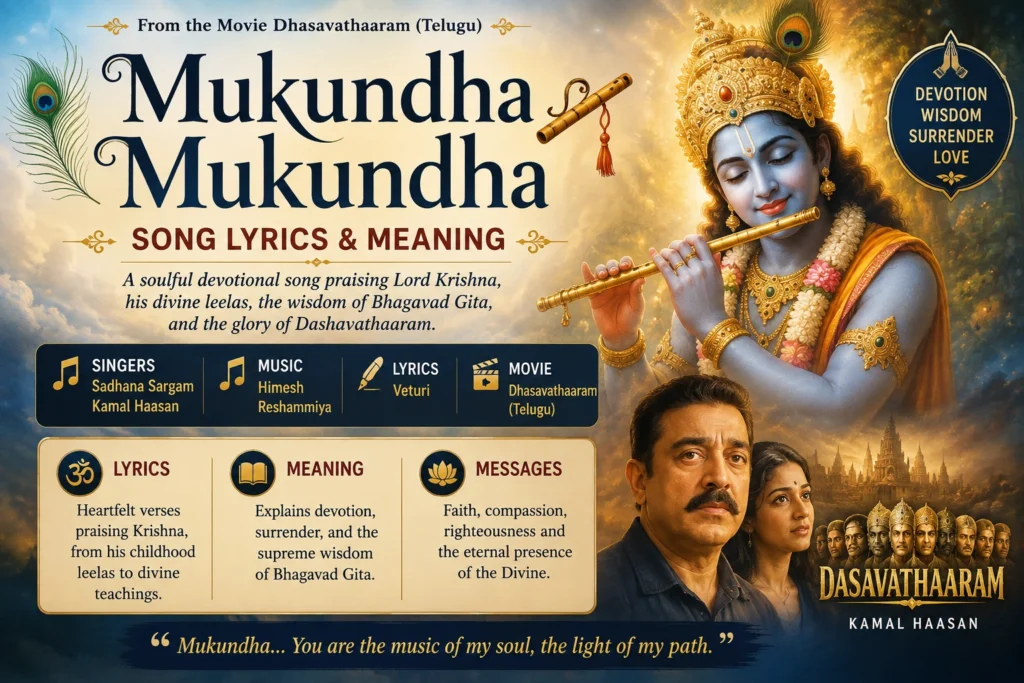
| Song Name | Mukundha Mukundha |
| Singer | Sadhana Sargam, Kamal Haasan |
| Album | Dhasavathaaram (2008) |
| Music Director | Himesh Reshammiya |
| Lyricist | Veturi Sundararama Murthy |
| Video Director | K. S. Ravikumar |
| Label | Sony Music Entertainment India Pvt. Ltd. |
| Details | Starring - Kamal Haasan, Asin |

Mukundha Mukundha Song Lyrics & Telugu, English and Hindi Meaning
Mukundha Mukundha song lyrics are from the Telugu version of the 2008 film Dhasavathaaram, starring Kamal Haasan and Asin. The song is a devotional composition centered on Lord Krishna and Vishnu, while also connecting Krishna’s teachings and different divine incarnations with the emotional world of the devotee.
The Telugu soundtrack credits Sadhana Sargam and Kamal Haasan as the singers, Himesh Reshammiya as the music composer, and the legendary Telugu lyricist Veturi Sundararama Murthy as the lyricist. The official Sony Music South video also identifies K. S. Ravikumar as the director and lists Kamal Haasan and Asin among the film’s stars.
The song is especially interesting because it does more than simply praise Krishna. It moves through several well-known stories associated with Krishna and Vishnu, including Krishna’s childhood, the Bhagavad Gita, and the Dashavatara tradition. The result is a devotional song that combines prayer, mythology, surrender and personal emotion.
For listeners searching for Mukundha Mukundha Telugu song lyrics, this guide explains the meaning and context of the song in a way that is easier to understand in English and Hindi. Rather than treating the words as isolated lines, we will look at what each major section is communicating and why the devotional references matter.
Mukundha Mukundha Song Details
| Details | Information |
|---|---|
| Song Name | Mukundha Mukundha |
| Movie | Dhasavathaaram |
| Language | Telugu |
| Year | 2008 |
| Singers | Sadhana Sargam & Kamal Haasan |
| Music | Himesh Reshammiya |
| Lyrics | Veturi Sundararama Murthy |
| Director | K. S. Ravikumar |
| Lead Actor | Kamal Haasan |
| Lead Actress | Asin |
| Music Label | Sony Music Entertainment India Pvt. Ltd. |
| Duration | Approximately 6 minutes 34 seconds |
Spotify lists “Mukundha Mukundha” as part of the Dhasavathaaram (Telugu) Original Motion Picture Soundtrack and credits Himesh Reshammiya, Sadhana Sargam and Kamal Haasan. The listing dates the soundtrack to 2008 and gives the track a duration of 6:34.
Mukundha Mukundha Song Lyrics – Tamil, English & Hindi Meaning
Mukundha Mukundha is a devotional song from the Tamil film Sivaji: The Boss. The song beautifully uses references to Lord Krishna and the different avatars of Lord Vishnu. Below is a mobile-friendly table featuring the supplied lyrics in Tamil, along with their English and Hindi meanings.
| Tamil Lyrics | English Meaning | Hindi Meaning |
|---|---|---|
முகுந்தா முகுந்தா கிருஷ்ணா முகுந்தா முகுந்தா வரம் தா வரம் தா பிருந்தாவனம் தா வனம் தா |
Mukundha, Krishna, please bless me. Grant me a boon and give me the sacred grace of Brindavan. | हे मुकुंद, हे कृष्ण, मुझे अपना आशीर्वाद दो। मुझे वरदान दो और वृंदावन की पवित्र कृपा प्रदान करो। |
வெண்ணை உண்ட வாயால் மண்ணை உண்டவா பெண்ணை உண்ட காதல் நோய்க்கு மருந்தாக வா |
You who ate butter, and even swallowed the earth as a child, come as the cure for the pain of love. | हे कृष्ण, जिन्होंने बचपन में मक्खन खाया और मिट्टी तक खा ली, प्रेम की पीड़ा के लिए औषधि बनकर आओ। |
முகுந்தா முகுந்தா கிருஷ்ணா முகுந்தா முகுந்தா வரம் தா வரம் தா பிருந்தாவனம் தா வனம் தா |
O Mukundha, O Krishna, bless me and grant me your divine grace. | हे मुकुंद, हे कृष्ण, मुझे आशीर्वाद दो और अपनी दिव्य कृपा प्रदान करो। |
என்ன செய்ய நானும் தோல் பாவை தான் உந்தன் கைகள் ஆட்டி வைக்கும் நூல் பாவை தான் |
What can I do? I am merely a puppet, moved by the strings controlled by your hands. | मैं क्या कर सकती हूँ? मैं तो केवल एक कठपुतली हूँ, जिसे तुम्हारे हाथों की डोर चलाती है। |
முகுந்தா முகுந்தா கிருஷ்ணா முகுந்தா முகுந்தா வரம் தா வரம் தா பிருந்தாவனம் தா வனம் தா |
O Mukundha, O Krishna, please grant me your blessing and the grace of Brindavan. | हे मुकुंद, हे कृष्ण, मुझे अपना आशीर्वाद और वृंदावन की कृपा प्रदान करो। |
ஜெய் ஜெய் ராம் ஜெய் ஜெய் ராம் சீதா ராம் ஜெய் ஜெய் ராம் ஜெய் ஜெய் ராம் ஜெய் ஜெய் ராம் |
Victory and praise to Lord Rama. Praise to Sita and Rama. | जय जय राम, भगवान राम की जय। सीता राम की जय। |
மச்சமாக நேரில் தோன்றி மறைகள் தன்னை காத்தாய் கூர்மமாக மண்ணில் தோன்றி பூமி தன்னை மீட்டாய் |
You appeared as Matsya and protected the sacred scriptures. You appeared as Kurma and supported the divine work of restoring the earth. | तुम मत्स्य रूप में प्रकट होकर पवित्र वेदों की रक्षा की। कूर्म रूप में प्रकट होकर पृथ्वी की रक्षा के कार्य में सहायक बने। |
வாமனன் போல் தோற்றம் கொண்டு வானளந்து நின்றாய் நரன் கலந்த சிம்மமாகி இரணியனை கொன்றாய் |
You appeared as Vamana and measured the worlds. You became Narasimha and destroyed Hiranyakashipu. | तुम वामन रूप में प्रकट होकर तीनों लोकों को अपने चरणों से नाप गए। नरसिंह रूप लेकर हिरण्यकशिपु का वध किया। |
ராவணன் தன் தலையை கொய்ய ராமனாக வந்தாய் கண்ணனாக நீயே வந்து காதலும் தந்தாய் |
You came as Rama and defeated Ravana. You came as Krishna and also gave the gift of divine love. | तुम राम बनकर आए और रावण का अंत किया। तुम कृष्ण बनकर आए और प्रेम का वरदान भी दिया। |
இங்கு உன் அவதாரம் ஒவ்வொன்றிலும் தான் உன் தாரம் நானே உன் திருவடி பட்டால் திருமணம் ஆகும் என்றிலே ஏங்குகிறேனே |
In every one of your divine incarnations, I long to be your beloved. I yearn for the day when touching your sacred feet will unite us in marriage. | तुम्हारे हर अवतार में मैं ही तुम्हारी प्रिय बनना चाहती हूँ। मैं उस दिन की प्रतीक्षा करती हूँ जब तुम्हारे पवित्र चरणों का स्पर्श हमारे विवाह का कारण बनेगा। |
மயில் பீலி சூடி நிற்கும் மன்னவனே மங்கைக்கு என்றும் நீயே மணவாளனே |
O king who stands adorned with peacock feathers, you are forever the bridegroom of this maiden. | हे मोर पंख धारण करने वाले प्रभु, तुम ही इस कन्या के सदा के वर हो। |
முகுந்தா முகுந்தா கிருஷ்ணா முகுந்தா முகுந்தா வரம் தா வரம் தா பிருந்தாவனம் தா வனம் தா |
O Mukundha, O Krishna, please bless me and grant me your divine grace. | हे मुकुंद, हे कृष्ण, मुझे आशीर्वाद दो और अपनी दिव्य कृपा प्रदान करो। |
உசுரோடிருக்கான் நான் பெத்த பிள்ள ஏனோ இன்னும் தகவல் வரல வானத்தில் இருந்து வந்து குதிப்பான் சொன்ன கேளுங்க அசடுகளே |
My beloved child is still alive, but I have not received any news yet. He may suddenly come down from the heavens; listen to what I am saying. | मेरा अपना बच्चा अभी जीवित है, फिर भी उसकी कोई खबर नहीं आई। वह शायद आसमान से अचानक आ जाएगा; मेरी बात सुनो। |
ஆராவமுதா அழகா வாடா உடனே வாடா வாடா ஆஆ கோவிந்தா கோபாலா ஹே |
O sweet and beautiful Lord, come to me. Come quickly, O Govinda, O Gopala. | हे अमृत समान मधुर और सुंदर प्रभु, मेरे पास आओ। जल्दी आओ, हे गोविंद, हे गोपाल। |
முகுந்தா முகுந்தா கிருஷ்ணா முகுந்தா முகுந்தா வரம் தா வரம் தா பிருந்தாவனம் தா வனம் தா |
O Mukundha, O Krishna, grant me your blessing and the sacred grace of Brindavan. | हे मुकुंद, हे कृष्ण, मुझे अपना आशीर्वाद और वृंदावन की पवित्र कृपा प्रदान करो। |
Mukundha Mukundha Song Meaning
The song is written as a devotional appeal to Lord Krishna and Lord Vishnu. The singer addresses Krishna as Mukundha and asks for blessings, divine grace and his presence.
One of the most beautiful ideas in the song is the comparison of the devotee to a puppet controlled by divine hands. The singer suggests that her life and actions are ultimately guided by Krishna.
The song then moves through several important forms and stories associated with Vishnu. Matsya, Kurma, Vamana, Narasimha, Rama and Krishna are referenced, creating a lyrical journey through divine incarnations.
Mukundha Mukundha and Lord Vishnu’s Avatars
A major section of the song refers to different avatars of Lord Vishnu. These references give the song its devotional depth while also connecting the character’s love and longing with Hindu mythology.
| Avatar / Form | Song Reference | Simple Explanation |
|---|---|---|
| Matsya | மச்சமாக | Vishnu’s fish incarnation, associated with protecting sacred knowledge and saving life during the great flood. |
| Kurma | கூர்மமாக | The tortoise incarnation of Vishnu, associated with supporting Mount Mandara during the churning of the ocean. |
| Vamana | வாமனன் | The dwarf incarnation who asked King Mahabali for three paces of land and then covered the worlds with his cosmic steps. |
| Narasimha | சிம்மமாகி | The half-man, half-lion form of Vishnu who defeated Hiranyakashipu. |
| Rama | ராமனாக | The avatar of Vishnu who defeated Ravana and is central to the Ramayana. |
| Krishna | கண்ணனாக | The beloved Krishna, associated with devotion, wisdom, compassion and divine love. |
Why the Puppet Metaphor Is Important
The line comparing the singer to a puppet is particularly meaningful in a devotional context. A puppet cannot move independently; its movements are controlled by another person.
In the same way, the singer expresses complete surrender to Krishna. She sees herself as being guided by his will and asks him to direct her life.
This idea of surrender is an important element of devotional poetry. Instead of presenting the relationship only as romantic love, the song blends personal longing with devotion to the divine.
Krishna as the Beloved
The song also uses the traditional image of Krishna as a beloved figure. The singer does not merely ask Krishna for a blessing; she expresses a desire to become his eternal companion.
The reference to Krishna wearing a peacock feather reinforces his familiar visual identity. The singer describes him as the eternal bridegroom and expresses her longing to be united with him.
This creates a beautiful combination of bhakti and romantic imagery. The emotional language can be understood both as the longing of a devotee for God and as the longing of a woman for her beloved.
What Does “Mukundha” Mean?
Mukundha is a name associated with Lord Vishnu and Krishna. The name is traditionally connected with the idea of the one who grants liberation or freedom from worldly bondage.
Therefore, repeatedly addressing Krishna as “Mukundha” gives the song a deeper devotional character. The singer is not simply calling a person’s name; she is invoking a divine name.
What Does “Brindhavanam” Mean?
Brindhavanam, commonly written as Vrindavan in English, is traditionally associated with Krishna’s childhood and youthful divine pastimes.
In the song, asking for “Brindhavanam” creates an image of the sacred world associated with Krishna. It expresses a desire to be close to the divine presence represented by Krishna’s Brindavan.
Mukundha Mukundha Song – Tamil, English and Hindi
For readers who are unfamiliar with Tamil, the three-column format makes the song easier to understand. The Tamil column preserves the original meaning and poetic character, while the English column explains the idea in simple language. The Hindi column provides an accessible interpretation for Hindi-speaking readers.
Some phrases in devotional songs should not be translated word-for-word because their cultural and religious meaning can become unclear. For that reason, the English and Hindi explanations above focus on the intended meaning and devotional context.
Important Themes in Mukundha Mukundha
- Devotion: The singer repeatedly calls upon Krishna for divine grace.
- Surrender: The puppet metaphor expresses complete surrender to God.
- Divine incarnations: Several avatars of Vishnu are referenced.
- Love: Krishna is presented as both a divine figure and beloved.
- Longing: The singer expresses her desire to meet and unite with Krishna.
- Blessing: The repeated request for a boon reflects the devotional nature of the song.
- Brindavan: The sacred setting associated with Krishna is invoked repeatedly.
Mukundha Mukundha Song: Easy Explanation
In simple words, the singer is saying:
“Krishna, you are my Lord and my beloved. Please come to me, bless me and guide me. You have appeared in many forms to protect the world. I surrender myself completely to you, and I long to become united with you.”
The song therefore works on two levels. On the surface, it can be enjoyed as a beautiful cinematic song about love and longing. At a deeper level, it is a devotional expression directed toward Krishna.
Frequently Asked Questions
1. What does Mukundha Mukundha mean?
“Mukundha Mukundha” is an invocation of Lord Krishna/Vishnu. Mukundha is a divine name associated with Lord Vishnu and carries the devotional idea of the giver of liberation.
2. Is Mukundha Mukundha a devotional song?
Yes. The song contains strong devotional elements and references Lord Krishna, Lord Rama and several avatars of Lord Vishnu. It combines devotion with romantic and emotional imagery.
3. What is the meaning of Brindhavanam in the song?
Brindhavanam, or Vrindavan, is traditionally associated with Krishna’s childhood and divine pastimes. In the song, it represents the sacred world and presence associated with Krishna.
4. Which avatars of Vishnu are mentioned?
The song refers to Matsya, Kurma, Vamana, Narasimha, Rama and Krishna. These references form an important devotional section of the song.
5. What does the puppet line mean?
The puppet metaphor expresses surrender. The singer compares herself to a puppet whose movements are controlled by Krishna, suggesting that she is placing her life and destiny in his hands.
6. Why does the song mention a peacock feather?
The peacock feather is strongly associated with Lord Krishna’s traditional iconography. Its mention helps establish the familiar visual image of Krishna.
7. Is the song about Krishna or Vishnu?
The song primarily addresses Krishna, who is traditionally regarded as an avatar or manifestation of Vishnu within Vaishnava traditions. The lyrics therefore move naturally between Krishna and Vishnu’s other incarnations.
8. What is the central message of Mukundha Mukundha?
The central message is a combination of devotion, surrender, longing and divine love. The singer asks Krishna to appear, bless her and unite with her.
Conclusion
Mukundha Mukundha is more than a conventional Tamil film song. Its lyrics combine the beauty of romantic longing with the spiritual language of devotion. By invoking Krishna as Mukundha and referring to several avatars of Vishnu, the song creates a strong connection between cinema, mythology and bhakti.
The repeated request for Krishna’s blessing, the image of the devotee as a puppet in divine hands, the references to Brindavan and the image of Krishna wearing a peacock feather all contribute to the song’s emotional depth.
For readers searching for Mukundha Mukundha song lyrics in Tamil, English and Hindi, the table above makes the supplied lyrics easier to read and understand across languages while preserving the devotional meaning of the song.
What Does Mukundha Mukundha Mean?
The word Mukunda is traditionally associated with Lord Vishnu and is also used as a name of Krishna. The devotional repetition of “Mukundha Mukundha” establishes the song’s central focus immediately: the devotee is addressing the divine.
The song then associates Krishna with Vrindavan, his childhood stories, divine play, spiritual teaching and the wider Vishnu tradition. This gives the composition a broad devotional scope.
At a simple level, the song can be understood as a prayer saying that human beings are dependent on the divine. Krishna is presented as the source of wisdom, protection, love and spiritual guidance.
The song also uses a personal voice. Instead of discussing mythology like a textbook, it turns those stories into an emotional relationship between the devotee and God.
Mukundha Mukundha Telugu Song Meaning
The Telugu song begins by invoking Krishna as Mukunda and describing the divine presence through musical and Vrindavan imagery. The opening idea connects Krishna with melody, beauty and blessing.
One of the early images recalls Krishna’s famous childhood identity as the playful butter thief. The devotional perspective transforms this mischievous childhood behavior into an affectionate description of Krishna.
The song then compares human beings to puppets whose actions ultimately remain within the divine order. This is an important philosophical idea: people may believe they control everything, but the devotional viewpoint sees life as dependent on God’s will.
From there, the song expands into stories associated with Krishna and Vishnu. The focus shifts from the playful child Krishna to the divine teacher and protector.
English Meaning of Mukundha Mukundha
The English meaning of Mukundha Mukundha can be summarized as a heartfelt devotional address to Krishna.
The speaker praises Krishna as the divine presence associated with Vrindavan, music, love and spiritual wisdom. Krishna’s childhood stories are remembered with affection, while his divine nature is treated with reverence.
The song suggests that human life is ultimately connected to God. People are like instruments or puppets in a larger divine order, and remembering Krishna becomes a way of finding spiritual understanding.
The song then refers to Krishna’s role in the Mahabharata and the Bhagavad Gita. Krishna’s guidance to Arjuna is presented as wisdom not only for one person but as a teaching with wider significance.
The later portion moves through several incarnations of Vishnu. The devotional message is that although divine appearances may take different forms, the underlying divine source remains one.
Hindi Meaning of Mukundha Mukundha
“Mukundha Mukundha” का हिंदी अर्थ भगवान कृष्ण और विष्णु की भक्ति से जुड़ा हुआ है। गीत में कृष्ण को एक ऐसे दिव्य रूप में याद किया गया है जो प्रेम, ज्ञान, सुरक्षा और आध्यात्मिक मार्गदर्शन का प्रतीक है।
गीत की शुरुआत कृष्ण के नाम के स्मरण से होती है। वृंदावन, कृष्ण की बाल लीलाएँ और उनकी मधुर बाँसुरी जैसे भाव भगवान के प्रेमपूर्ण रूप को सामने लाते हैं।
इसके बाद गीत का भाव अधिक आध्यात्मिक हो जाता है। मनुष्य के जीवन को ईश्वर की इच्छा से जुड़ा हुआ माना जाता है। व्यक्ति स्वयं को स्वतंत्र समझ सकता है, लेकिन भक्ति की दृष्टि से उसके जीवन की अंतिम दिशा ईश्वर से जुड़ी रहती है।
गीत में भगवान कृष्ण द्वारा अर्जुन को दिए गए गीता के उपदेश की ओर भी संकेत मिलता है। यहाँ कृष्ण केवल एक प्रिय देवता नहीं बल्कि ज्ञान और धर्म का मार्ग दिखाने वाले गुरु के रूप में दिखाई देते हैं।
गीत के आगे के हिस्से में विष्णु के विभिन्न अवतारों का उल्लेख आता है। इससे यह भाव मजबूत होता है कि अलग-अलग युगों में भगवान अलग-अलग रूपों में प्रकट होकर धर्म और संसार की रक्षा करते हैं।
Mukundha Mukundha Lyrics: Main Theme
The central theme of the song is devotion. However, several smaller themes work together to create that devotional feeling.
| Theme | Meaning |
|---|---|
| Devotion | Remembering and surrendering to Krishna. |
| Divine Love | Krishna is presented as a source of love and affection. |
| Wisdom | The Bhagavad Gita represents Krishna as a spiritual teacher. |
| Protection | Vishnu’s incarnations represent divine intervention and protection. |
| Surrender | The devotee accepts that human life is connected to divine will. |
| Unity of the Divine | Different avatars are presented as manifestations of the same divine source. |
Krishna’s Childhood References in the Song
One of the charming aspects of the song is that it does not begin with a distant or frightening image of God. Krishna appears through familiar childhood stories.
The reference to stealing butter and eating earth recalls stories of Krishna’s childhood in which his playful behavior becomes part of his divine identity.
This mixture of mischief and divinity is one of the most recognizable characteristics of Krishna’s traditional stories. He can simultaneously be seen as a playful child, beloved companion, divine protector and supreme spiritual teacher.
That makes the opening of the song emotionally accessible. The listener is introduced to Krishna not only as an abstract theological figure but as a beloved and familiar divine personality.
The Meaning of the Vrindavan Reference
Vrindavan is strongly associated with Krishna’s childhood and youthful stories. It is one of the most important places in Krishna traditions, especially those involving his relationship with the Gopikas and his playful divine activities.
When the song invokes Vrindavan, it immediately brings a world of music, devotion, love and divine play into the listener’s imagination.
The song’s musical language and devotional imagery therefore work together. Krishna is associated with melody, while Vrindavan becomes the symbolic environment where that divine music belongs.
The Bhagavad Gita Connection
One of the most important sections of Mukundha Mukundha refers to Krishna’s guidance to Arjuna.
In the Bhagavad Gita, Krishna advises Arjuna during the Kurukshetra conflict. The dialogue explores duty, action, knowledge, devotion and the nature of the self.
The song presents Krishna’s teaching as wisdom that extends beyond the immediate situation of Arjuna. The idea is that divine knowledge can guide human beings in their own struggles and uncertainties.
This gives the song a deeper meaning. It is not simply asking Krishna for blessings. It is also acknowledging Krishna as a source of knowledge.
For readers interested in the original philosophical source, the Gita Supersite from IIT Kanpur provides access to the Bhagavad Gita and related traditional texts.
Understanding the Dashavatara References
The later section of the song moves through the familiar Dashavatara tradition, in which Vishnu is described through a series of divine incarnations.
The song refers to forms including Matsya, Kurma, Vamana, Narasimha and Rama, before returning to Krishna.
Each reference is brief, but each carries a larger mythological story.
| Avatar | General Association | Devotional Idea |
|---|---|---|
| Matsya | Fish incarnation | Protection and preservation |
| Kurma | Tortoise incarnation | Support and stability |
| Vamana | Dwarf incarnation | Divine intervention and humility |
| Narasimha | Man-lion incarnation | Protection of devotion and destruction of evil |
| Rama | Prince and king of Ayodhya | Dharma, duty and righteous action |
| Krishna | Divine teacher and beloved deity | Love, wisdom and devotion |
The purpose of this sequence is not simply to list mythological characters. It shows the continuity of the divine across different forms and stories.
Why Mukundha Mukundha Feels Like a Devotional Song
The song’s devotional character comes from the combination of several elements.
- Repeated divine invocation: The repeated name of Mukunda functions like a musical prayer.
- Mythological storytelling: Familiar stories make the devotional message concrete.
- Personal surrender: The devotee presents the self as dependent upon the divine.
- Spiritual wisdom: Krishna’s role as teacher adds philosophical depth.
- Avatara imagery: Vishnu’s incarnations reinforce the idea of divine protection.
- Musical repetition: The recurring refrain makes the devotional theme memorable.
Mukundha Mukundha and Dhasavathaaram
The connection between the song and Dhasavathaaram is particularly appropriate because the movie’s title itself refers to the ten incarnations of Vishnu.
The song therefore fits naturally into the film’s broader thematic world. Instead of functioning only as a standalone devotional number, it reinforces the religious and mythological ideas associated with the movie.
The official Sony Music South release identifies the track as part of the Telugu version of Dhasavathaaram and credits the principal creative team.
Amazon Music also lists the song under the Telugu original motion-picture soundtrack and identifies Sadhana Sargam, Kamal Haasan, Himesh Reshammiya and Veturi Sundararama Murthy in the track information.
How to Understand Mukundha Mukundha Song Lyrics
If you are hearing the song for the first time, the large number of religious references can initially seem difficult to follow. A simple approach is to divide the song into thematic sections.
- Invocation: Krishna is called by the name Mukunda.
- Vrindavan imagery: The song evokes Krishna’s beloved childhood world.
- Childhood Krishna: His playful stories are remembered affectionately.
- Human dependence: The song reflects on the relationship between people and God.
- Krishna as teacher: The Bhagavad Gita and Arjuna are invoked.
- Vishnu’s incarnations: Several avatars are remembered.
- Personal devotion: The speaker ultimately presents himself or herself as devoted to Krishna.
Following this structure makes the lyrics much easier to understand than translating every phrase separately.
English vs Hindi Meaning
| Aspect | English Explanation | Hindi Explanation |
|---|---|---|
| Devotion | A prayerful remembrance of Krishna. | कृष्ण की भक्ति और स्मरण। |
| Krishna | Presented as beloved deity, protector and teacher. | प्रिय देवता, रक्षक और गुरु के रूप में कृष्ण। |
| Gita | Symbolizes divine wisdom and guidance. | दिव्य ज्ञान और मार्गदर्शन का प्रतीक। |
| Avatars | Different forms through which Vishnu protects the world. | विष्णु के विभिन्न अवतार जो संसार की रक्षा करते हैं। |
| Surrender | Accepting divine guidance and dependence. | ईश्वर के मार्गदर्शन को स्वीकार करना। |
The Importance of Veturi’s Lyrics
The lyrics are credited to Veturi Sundararama Murthy, one of the most respected names in Telugu film lyric writing. In this song, the writing has to perform a difficult task: it must communicate mythology while remaining musical and emotionally accessible.
Rather than presenting mythology as a dry sequence of events, the lyrics connect stories with emotion. Krishna’s childhood, divine wisdom and different avatars become part of a single devotional conversation.
This is especially effective in a film soundtrack because the listener does not need to know every theological detail to feel the devotion. The names and images themselves carry emotional associations for many Telugu-speaking audiences.
Himesh Reshammiya’s Musical Contribution
Himesh Reshammiya composed the music for the Telugu soundtrack. The song has a long-form devotional structure, allowing the composition to move through several lyrical ideas rather than remaining a short repeated hook.
The repeated refrain gives the song a prayer-like quality, while the verses allow the narrative and mythological material to develop.
This balance between repetition and progression is important for devotional music. Repetition creates remembrance, while the verses provide meaning and storytelling.
Sadhana Sargam and Kamal Haasan’s Vocals
The song features Sadhana Sargam and Kamal Haasan. Their voices give the track a duet character while maintaining its devotional identity.
The vocal presentation is particularly useful for a song that shifts between intimate devotion and larger mythological descriptions. The singing allows the repeated invocation of Krishna to remain emotionally prominent even as the lyrics move into stories of Vishnu’s incarnations.
Spotify and Amazon Music both list Sadhana Sargam and Kamal Haasan among the principal performers for the track.
Common Search Terms for This Song
People may search for the same song using several different spellings. Some common variations include:
- Mukundha Mukundha song lyrics
- Mukunda Mukunda lyrics
- Mukundha Mukundha Telugu lyrics
- Mukunda Mukunda Telugu song
- Mukundha Mukundha lyrics in English
- Mukundha Mukundha Hindi meaning
- Mukundha Mukundha Krishna song
- Dhasavathaaram Telugu Mukundha Mukundha song
- Kamal Haasan Mukundha Mukundha song
- Sadhana Sargam Mukundha Mukundha
These spelling differences happen because Telugu words can be transliterated into English in several ways. “Mukunda,” “Mukundha,” and similar forms can all be used when people type the title using Roman letters.
Tips for Understanding Telugu Devotional Songs
- Learn the divine names: Names such as Krishna, Mukunda, Madhava and Govinda often have specific devotional meanings.
- Identify the mythology: Recognizing an avatar or story can unlock an entire verse.
- Separate transliteration from translation: Romanized Telugu helps pronunciation but does not explain meaning.
- Look for repeated refrains: Repetition often identifies the central devotional message.
- Consider the film context: A devotional song within a movie may serve a narrative purpose as well as a religious one.
- Read reliable background material: University and recognized cultural resources can help clarify references to Indian scriptures and traditions.
Common Mistakes to Avoid
1. Treating the Song as Only a Krishna Love Song
The song contains emotional language associated with Krishna, but its scope is much wider. It includes spiritual wisdom, Vishnu’s avatars and devotional surrender.
2. Missing the Dashavatara Connection
The sequence of divine incarnations is one of the song’s defining features. Understanding it makes the later verses much clearer.
3. Confusing Transliteration With Meaning
For example, writing “Mukundha Mukundha” in English letters only represents the sound. It does not explain the devotional significance of the name.
4. Ignoring the Bhagavad Gita Reference
The reference to Arjuna and Krishna’s teaching gives the song a philosophical dimension. It is not merely a collection of mythological stories.
5. Assuming Every Translation Is Word-for-Word
Poetic Telugu often uses compact expressions that sound natural in the original language but require a more explanatory translation in English or Hindi.
Related Song Meaning Guides
If you enjoy Telugu songs with explanations and multilingual meaning, explore the SongSubtext homepage for more song-analysis articles.
You can also read the Kalyani Song Meaning & English Lyrics Translation, which provides English and Hindi explanations of another South Indian song.
For a different South Indian classic, see the Nilave Vaa Song Lyrics, Meaning and Translation.
Where to Listen to Mukundha Mukundha
The official Sony Music South YouTube upload is a useful source for listening to the song and confirming the film and production credits.
The song is also listed on Spotify as part of the Dhasavathaaram (Telugu) Original Motion Picture Soundtrack.
Amazon Music also carries the track and lists it under the 2008 Telugu soundtrack.
For the best experience, listeners should use official or licensed music services when available, particularly when sharing or embedding music online.
Frequently Asked Questions About Mukundha Mukundha
1. What is Mukundha Mukundha?
Mukundha Mukundha is a Telugu devotional song from the 2008 film Dhasavathaaram. It focuses on Lord Krishna and the wider Vishnu tradition.
2. Who sang Mukundha Mukundha?
The Telugu version was sung by Sadhana Sargam and Kamal Haasan. Both Spotify and Amazon Music list them as performers on the track.
3. Who wrote Mukundha Mukundha lyrics?
The lyrics are credited to the celebrated Telugu lyricist Veturi Sundararama Murthy. The official Sony Music South video and music listings identify Veturi as the lyricist.
4. Who composed the music for Mukundha Mukundha?
Himesh Reshammiya composed the music for the Telugu version of the song.
5. Which movie contains Mukundha Mukundha?
The song appears in the Telugu version of the 2008 movie Dhasavathaaram, directed by K. S. Ravikumar and starring Kamal Haasan and Asin.
6. What is the meaning of Mukunda?
Mukunda is a traditional name associated with Lord Vishnu and Krishna. In the song, the repeated invocation of Mukunda functions as a devotional address to the divine.
7. Is Mukundha Mukundha a Krishna devotional song?
Yes. Krishna is at the center of the song, but the composition also expands into the broader Vishnu tradition and references several avatars.
8. Does the song mention the Bhagavad Gita?
Yes. The lyrics refer to Krishna’s guidance to Arjuna, connecting the song with the spiritual teaching associated with the Bhagavad Gita.
Conclusion
Mukundha Mukundha song lyrics are much more than a simple devotional refrain. The song creates a broad spiritual portrait of Krishna by bringing together his playful childhood, Vrindavan imagery, divine love, the wisdom given to Arjuna and the different incarnations of Vishnu.
For Telugu listeners, the song combines familiar devotional references with the emotional power of cinema. For English-speaking audiences, understanding the mythology behind the verses makes the song considerably richer. The Hindi interpretation similarly reveals the song as a prayer of प्रेम, भक्ति, ज्ञान and समर्पण.
✅ You May Also Like:
The song’s structure is especially effective. It begins with an intimate invocation of Krishna, moves into childhood stories, expands into spiritual philosophy, and then travels through Vishnu’s incarnations. By the end, all of these stories return to the same central idea: the divine can appear in different forms, but devotion connects them together.
The contribution of the creative team is also important. Veturi’s lyrics give the song its poetic and devotional language, Himesh Reshammiya provides the musical framework, and Sadhana Sargam and Kamal Haasan bring the words to life through their vocals. The official Sony Music South release confirms these principal credits.
If you came here searching for Mukundha Mukundha Telugu song lyrics, the most useful way to approach the song is not simply to read the words but to understand the stories behind them. Once Krishna’s childhood, Vrindavan, the Bhagavad Gita and the Dashavatara tradition are recognized, the devotional message becomes much clearer.
Ultimately, Mukundha Mukundha presents Krishna as beloved deity, teacher, protector and divine presence. That combination of mythology and personal devotion is what gives the song its lasting emotional appeal.
Sources and Further Reading
- Official Sony Music South video for Mukundha Mukundha
- Mukundha Mukundha on Spotify
- Mukundha Mukundha on Amazon Music
- IIT Kanpur Gita Supersite
Copyright note: The original lyrics of the song are copyrighted by their respective rights holders. This article focuses on song information, interpretation, cultural context and meaning rather than reproducing the complete copyrighted lyrics.
About This Article
| Reviewed By | Music Research Team |
|---|---|
| Content Type | Song Meaning, Translation, Background & Educational Analysis |
| Published | September 3, 2026 |
| Last Updated | September 3, 2026 |
| Reading Time | 21 min read |
| Article Purpose | Provide educational analysis, song meaning, translation, artist information, and verified music facts. |
Sources
This article has been prepared using publicly available music information and reliable editorial references. Song details, artist information, and album metadata have been verified using the following official and trusted sources whenever available.
- Official Artist Website
- Official Record Label
- Spotify
- Apple Music
- YouTube Music
- MusicBrainz
- Discogs
- AllMusic
- IMDb (where applicable)
Copyright Notice
Copyright Disclaimer & DMCA Notice:
Song lyrics are protected by copyright law and are the exclusive property of their respective owners. The lyrics and translations provided on this website are published for educational, commentary, research, and informational purposes only.
Notice to Copyright Holders:If you are a copyright owner or an authorized agent and believe that any content on this website infringes upon your copyrights, please contact us at info@songsubtext.com.
We respect intellectual property rights and will promptly remove any infringing material upon valid request.
Editorial Policy
Our editorial team researches every article using reliable music databases, official artist information, album credits, and trusted industry resources. Every page is reviewed for originality, accuracy, and compliance with copyright regulations.