
Notre Dame Fight Song Lyrics & Meaning
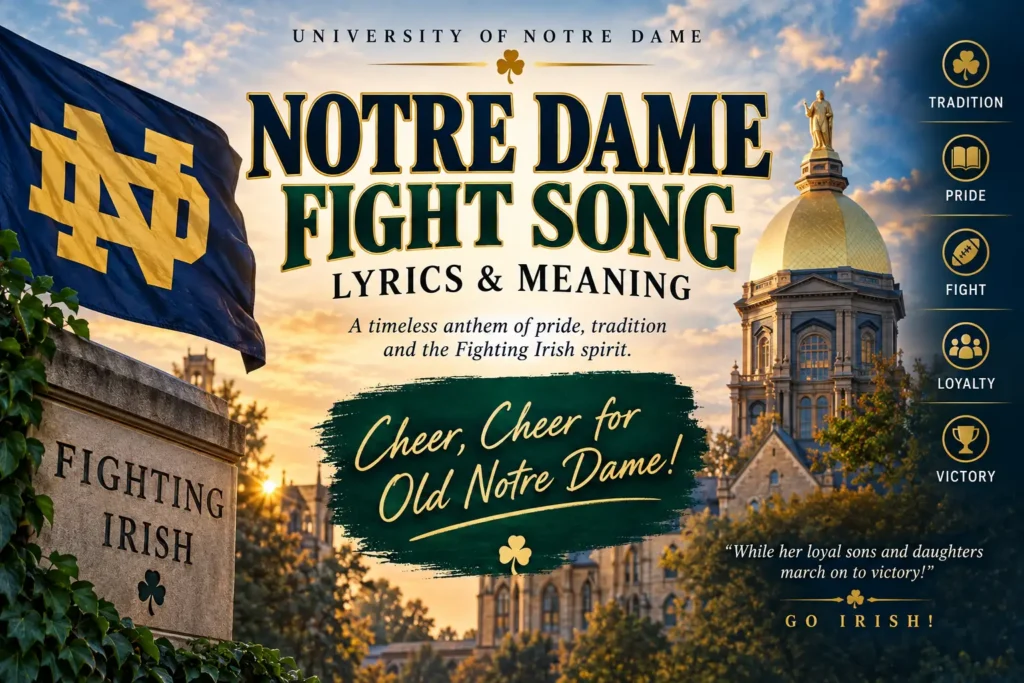
When people search for Notre Dame fight song lyrics or simply Notre Dame fight lyrics, they are usually looking for one famous song: the Notre Dame Victory March, the traditional fight song associated with the University of Notre Dame and the Fighting Irish.
The song is much more than a tune played during a football game. Its words celebrate Notre Dame, encourage loyalty, emphasize determination and transform a sporting moment into a shared expression of university identity. The repeated calls to cheer, fight, remember the school and march toward victory explain why the song has remained recognizable for generations.
The Notre Dame Victory March dates back to the early twentieth century. It was written by Notre Dame graduates and brothers Rev. Michael J. Shea and John F. Shea. According to the University of Notre Dame, Michael Shea composed the music while John Shea wrote the words. The song was copyrighted in 1908 and later became deeply connected with Notre Dame athletics. Notre Dame’s official Victory March page provides the university’s historical background and the current version of the song.
This guide explains what the Notre Dame fight song is, where it came from, what its major lyrical ideas mean, why the wording changed in 2022, and how the song functions as part of the Fighting Irish game-day tradition.
| Original Lyrics | Hindi Translation | Tamil Translation |
|---|---|---|
| Notre Dame “Notre Dame Victory March” |
नोट्रे डेम “नोट्रे डेम विजय मार्च” |
நோட்ரே டேம் “நோட்ரே டேம் வெற்றி அணிவகுப்பு” |
| Rally sons of Notre Dame | नोट्रे डेम के वीर पुत्रों, एकजुट हो जाओ | நோட்ரே டேமின் மக்களே, ஒன்றிணைந்து எழுங்கள் |
| Sing her glory and sound her fame | उसकी महिमा गाओ और उसकी कीर्ति का जयघोष करो | அவளின் மகிமையைப் பாடி, அவளின் புகழை முழங்குங்கள் |
| Raise her Gold and Blue | उसके सुनहरे और नीले ध्वज को ऊँचा उठाओ | அவளின் பொன் மற்றும் நீல நிறங்களை உயர்த்துங்கள் |
| And cheer with voices true: | और सच्चे उत्साह से अपनी आवाज़ बुलंद करो: | உண்மையான உற்சாகத்துடன் குரல் கொடுங்கள்: |
| Rah, rah, for Notre Dame | राह, राह, नोट्रे डेम के लिए जयकार करो | ரா, ரா, நோட்ரே டேமுக்காக ஆரவாரம் செய்யுங்கள் |
| We will fight in every game, | हम हर खेल में पूरी ताकत से लड़ेंगे | ஒவ்வொரு போட்டியிலும் நாங்கள் முழு உறுதியுடன் போராடுவோம் |
| Strong of heart and true to her name | हम हृदय से मजबूत और उसके नाम के प्रति सच्चे रहेंगे | இதயத்தில் வலிமையுடனும், அவளின் பெயருக்கு உண்மையுடனும் இருப்போம் |
| We will ne’er forget her | हम उसे कभी नहीं भूलेंगे | அவளை நாம் ஒருபோதும் மறக்கமாட்டோம் |
| And will cheer her ever | और हमेशा उसके लिए जयकार करते रहेंगे | அவளுக்காக எப்போதும் ஆரவாரம் செய்வோம் |
| Loyal to Notre Dame. | नोट्रे डेम के प्रति सदैव वफादार रहेंगे। | நோட்ரே டேமுக்கு எப்போதும் விசுவாசமாக இருப்போம். |
| Cheer, cheer for Old Notre Dame, | जयकार करो, पुराने नोट्रे डेम के लिए जयकार करो | ஆரவாரம் செய்யுங்கள், பழைய நோட்ரே டேமுக்காக ஆரவாரம் செய்யுங்கள் |
| Wake up the echoes cheering her name, | उसके नाम की जयकार से गूंजों को जगा दो | அவளின் பெயரை முழங்கி, எதிரொலிகளை எழுப்புங்கள் |
| Send a volley cheer on high, | ऊँचाई तक जयकारों की गूंज भेजो | உயரத்திற்கு ஆரவாரத்தின் முழக்கத்தை அனுப்புங்கள் |
| Shake down the thunder from the sky! | आसमान से गरजती बिजली को भी हिला दो! | வானிலிருந்து இடியின் முழக்கத்தையே அதிரச் செய்யுங்கள்! |
| What though the odds be great or small, | चाहे परिस्थितियाँ हमारे पक्ष में हों या हमारे विरुद्ध, | வாய்ப்புகள் பெரியதாக இருந்தாலும் சிறியதாக இருந்தாலும், |
| Old Notre Dame will win over all, | पुराना नोट्रे डेम सब पर विजय प्राप्त करेगा | பழைய நோட்ரே டேம் அனைவரையும் வென்று முன்னேறும் |
| While her loyal sons and daughters* | जबकि उसके वफादार पुत्र और पुत्रियाँ | அவளின் விசுவாசமான மகன்களும் மகள்களும் |
| March on to victory! | विजय की ओर आगे बढ़ते जाएँगे! | வெற்றியை நோக்கி முன்னேறிச் செல்வார்கள்! |
| * Note: The University of Notre Dame has officially changed the lyrics to its fight song, “Victory March,” after 114 years. | ||
| Previously: “While her loyal sons are marching onward to victory.” |
पहले: “जबकि उसके वफादार पुत्र विजय की ओर आगे बढ़ रहे हैं।” |
முன்பு: “அவளின் விசுவாசமான மகன்கள் வெற்றியை நோக்கி முன்னேறிச் செல்கிறார்கள்.” |
| Updated as of Jun 3, 2022: “While her loyal sons and daughters march on to victory.” |
3 जून 2022 से संशोधित: “जबकि उसके वफादार पुत्र और पुत्रियाँ विजय की ओर आगे बढ़ते हैं।” |
3 ஜூன் 2022 முதல் புதுப்பிக்கப்பட்டது: “அவளின் விசுவாசமான மகன்களும் மகள்களும் வெற்றியை நோக்கி முன்னேறிச் செல்கிறார்கள்.” |
What Is the Notre Dame Fight Song?
The song commonly called the Notre Dame fight song is officially known as the “Notre Dame Victory March.” It is the principal fight song associated with the University of Notre Dame.
A fight song is designed to create collective energy. Rather than telling a long narrative, it relies on memorable phrases, repetition, rhythmic language and direct calls to action. The Notre Dame Victory March follows that tradition closely.
The lyrics repeatedly communicate three central ideas:
- Cheer for Notre Dame: supporters are encouraged to raise their voices and celebrate the university.
- Fight through competition: the song links athletic competition with determination and courage.
- Remain loyal: victory matters, but so does continued devotion to the institution.
The phrase most listeners immediately recognize begins with “Cheer, cheer for old Notre Dame”. That opening invitation establishes the communal character of the song: it is meant to be sung together rather than simply performed for an audience.
Who Wrote the Notre Dame Fight Song Lyrics?
The history of the Notre Dame Victory March begins with two brothers from Notre Dame: Michael J. Shea and John F. Shea.
Michael Shea was responsible for the music, while John Shea wrote the lyrics. The brothers were both Notre Dame graduates, and their work eventually produced one of the university’s most recognizable traditions.
The University of Notre Dame’s Band history explains that the brothers first worked on the song in 1908. Michael performed the music on the organ at the Second Congregational Church in Holyoke, Massachusetts, where the composition began to take shape as a public musical work.
The Notre Dame athletic department similarly records 1908 as the year of composition and publication. The song was subsequently performed at Notre Dame and became increasingly associated with university athletics.
When Was the Notre Dame Victory March First Performed?
The early history of the song contains an interesting detail that is easy to miss when searching for Notre Dame fight lyrics.
The University of Notre Dame’s historical sources describe the song’s beginnings in 1908, when Michael Shea played it on the organ in Holyoke. The Notre Dame Band history states that it was first performed at Notre Dame on Easter Sunday in 1909.
However, Notre Dame Magazine has also documented an earlier campus appearance on December 1, 1908, when the song was performed by the Notre Dame Glee Club with the university orchestra at an event honoring University President Rev. John W. Cavanaugh. The magazine notes that the song soon became part of athletic traditions, particularly at baseball and football games.
This distinction is useful because it shows that the song’s history was not simply one dramatic debut followed by instant fame. Its relationship with Notre Dame developed over time. The song gradually became associated with the athletic culture that audiences recognize today.
What Do the Notre Dame Fight Song Lyrics Mean?
At its heart, the Notre Dame Victory March is a song about collective confidence, loyalty and determination.
Rather than focusing on one particular player, coach or season, the lyrics address Notre Dame itself. The university becomes the central subject of affection and loyalty. Supporters are asked to remember the school, celebrate its identity and encourage its teams.
The first part emphasizes honoring Notre Dame and publicly celebrating its reputation. References to the university’s Gold and Blue connect the song to Notre Dame’s visual identity, while the repeated calls to cheer make participation part of the musical experience.
Another important idea is persistence. The song presents competition as something that should be approached with strength and confidence regardless of circumstances.
That explains one of its most enduring ideas: the size of the challenge does not determine the level of commitment. Whether the odds are favorable or difficult, the supporter is encouraged to believe in Notre Dame and continue marching toward victory.
Understanding the “Cheer, Cheer for Old Notre Dame” Section
The best-known section of the Notre Dame fight song works almost like a chant.
The opening command to cheer is followed by imagery of echoes, thunder and a great collective voice. These images make the university seem larger than the stadium itself.
The reference to “echoes” is particularly effective. An echo suggests that a voice does not disappear after it is shouted. Instead, it returns and spreads. In a sports setting, that becomes a metaphor for tradition: generations of students and supporters may leave the stadium, but the identity of Notre Dame continues.
The language of thunder creates another layer of energy. Thunder is powerful, dramatic and impossible to ignore. The song uses that image to turn a crowd’s enthusiasm into something almost physical.
This is one reason the Notre Dame fight song lyrics remain effective during live events. The words are easy to connect with even when a listener does not know every historical detail behind them.
The Meaning of “Fight” in the Song
Many people who search Notre Dame fight lyrics assume that the song is primarily about fighting an opponent. The word actually functions more broadly.
In the context of a college fight song, “fight” means striving, competing, refusing to give up and representing the institution with determination. The song uses athletic language, but its message can also be interpreted as a statement about character.
The lyrics associate Notre Dame with being strong of heart and true to its name. In other words, athletic victory is connected with values such as loyalty and commitment.
This is why fight songs often survive changes in players and seasons. A team roster can change every year, but the song belongs to the larger institution.
Notre Dame Fight Song Lyrics and the “Sons and Daughters” Change
One of the most important modern changes to the song occurred in 2022.
The final part of the traditional lyrics had historically referred only to the university’s “sons.” As Notre Dame’s student body and athletic programs evolved, the university officially updated the wording to recognize both men and women.
The ending was changed to refer to “sons and daughters” marching to victory.
Notre Dame announced the change in connection with the 50th anniversary of the admission of undergraduate women. The university explained that the updated wording was intended to recognize the women of Notre Dame and the university’s contemporary student-athlete community.
The change is significant because it demonstrates how a traditional song can retain its melody and identity while updating language to reflect the people who now represent the institution.
The University’s current athletic page presents the updated wording as the modern version of the song.
Notre Dame Victory March: Lyrics vs. Meaning
| Lyric idea | Simple meaning | Why it matters |
|---|---|---|
| Cheering for Notre Dame | Support the university openly and proudly | Creates a shared identity among fans and students |
| Raising the Gold and Blue | Represent Notre Dame’s colors and identity | Connects the song with university symbolism |
| Fighting in every game | Compete with determination | Expresses the traditional spirit of a fight song |
| Remembering Notre Dame | Remain loyal beyond a single event | Turns athletic support into institutional pride |
| Thunder and echoes | Create an image of a powerful collective voice | Captures the atmosphere of a stadium crowd |
| Sons and daughters | Recognize the broader Notre Dame community | Reflects the university’s modern student-athlete population |
Why the Notre Dame Fight Song Is So Memorable
The effectiveness of the Notre Dame Victory March comes from the combination of music and language.
First, the rhythm is direct. A marching rhythm naturally encourages people to clap, sing and move together.
Second, the wording is repetitive. Repetition is important in songs intended for large groups because listeners can participate even without memorizing every section.
Third, the message is uncomplicated. The song does not require a detailed explanation before it can be enjoyed. A listener immediately understands that the university is being praised and its teams are being encouraged.
Fourth, tradition reinforces memory. Every time the song is performed, it becomes connected with another Notre Dame event, another game and another generation of supporters.
The University’s own historical material describes the Victory March as one of the most recognizable college fight songs and notes the role of its energetic rhythm in encouraging audience participation.
The Role of the Notre Dame Band
The song’s identity cannot be separated from the musical tradition of Notre Dame.
The University of Notre Dame Band has been part of campus life since the nineteenth century. The band remains central to game-day musical traditions and helps give the Victory March its unmistakable stadium character.
One important figure in the development of the sound audiences hear today was Joseph Casasanta, a former Notre Dame band director. University histories explain that Casasanta arranged the Victory March into the fuller form associated with later performances.
This is an important distinction: writing a song and creating the arrangement that generations of audiences come to recognize are not always the same thing. The original work came from the Shea brothers, while later musical treatment helped establish the performance style associated with the modern Notre Dame tradition.
Notre Dame Fight Song at Football Games
For many fans, the easiest way to understand the significance of the song is to hear it in the context of a football weekend.
The Victory March functions as a musical signal. When it begins, spectators immediately recognize that they are participating in something larger than the action on the field.
A fight song can connect different parts of a game-day experience:
- Students can sing it together.
- Alumni can recognize a familiar tradition from their own university years.
- Fans can use it as a celebration after a major play or victory.
- The marching band can transform the song into a large-scale stadium performance.
- Players and supporters share the same institutional language.
The song’s long history also helps create continuity. A current Notre Dame supporter may be hearing the same fundamental composition that earlier generations heard, even though arrangements and wording have evolved.
Notre Dame Fight Song vs. Notre Dame Alma Mater
Another common source of confusion is the difference between the Notre Dame Victory March and the university’s alma mater, “Notre Dame, Our Mother.”
| Feature | Notre Dame Victory March | Notre Dame, Our Mother |
|---|---|---|
| Role | Fight song | Alma mater |
| Main purpose | Athletic energy and university spirit | Affection and reverence for the university |
| Common tone | Energetic and triumphant | Reflective and ceremonial |
| Associated with | Games, cheering and athletics | University tradition and formal occasions |
Both songs are important, but they serve different emotional purposes. The Victory March is designed to raise energy, while the alma mater expresses a quieter and more reflective sense of belonging.
What Does “Old Notre Dame” Mean?
The expression “old Notre Dame” should not be interpreted as meaning an old or outdated university.
In traditional school songs, phrases such as “old” often communicate affection, heritage and continuity. The word gives the institution a sense of history and familiarity.
In this context, “old Notre Dame” is essentially an affectionate way of referring to the university and the traditions surrounding it.
Why “Gold and Blue” Matters
The reference to Gold and Blue is another example of how the lyrics turn institutional symbols into music.
University colors are easy for a crowd to recognize visually, while a song can reinforce those same colors emotionally. When supporters sing about Notre Dame’s colors, they are not simply describing two shades. They are expressing affiliation with the university.
This technique is common among school songs. Colors, mascots, locations and nicknames often become shorthand for a much larger community.
A Simple Interpretation of the Complete Song
The overall message of the Notre Dame Victory March can be summarized in a few ideas.
- Honor Notre Dame. The university deserves to be celebrated and remembered.
- Support the team. Fans should actively encourage Notre Dame during competition.
- Stay strong. Difficult odds should not eliminate confidence or commitment.
- Remain loyal. Notre Dame represents something larger than a single game.
- Celebrate together. The song is designed for a community, not an isolated listener.
That simplicity is part of its strength. A young student, a longtime alumnus and a first-time viewer can all understand the basic emotional message.
How the Notre Dame Fight Song Changed Over Time
The Victory March has remained recognizable because its core identity has stayed stable while its presentation has developed.
The Shea brothers created the original song in 1908. Later arrangements helped shape the sound familiar to modern listeners. The song also became increasingly connected with football as Notre Dame athletics gained national prominence during the twentieth century. Notre Dame Magazine notes that the song was not initially associated exclusively with football and that its connection with athletics developed over time.
The 2022 wording update represents another kind of evolution. The melody remained the same while the final wording was changed to recognize both sons and daughters of Notre Dame.
This combination of continuity and change is one of the reasons the song remains relevant. Tradition does not necessarily mean that every word must remain frozen forever.
Where to Read the Official Notre Dame Fight Song Lyrics
Readers searching for the exact Notre Dame fight song lyrics should use an authoritative source whenever possible because online lyric pages can contain outdated wording, formatting errors or older versions of a song.
The official Notre Dame Athletics Victory March page provides the university’s song information and current wording. The University’s Scholastic guide to the alma mater and fight song is also useful for understanding how students are taught to sing the tradition.
For historical research, the Notre Dame Band history page provides additional background about the song’s creators and the development of its arrangement.
Tips for Understanding Notre Dame Fight Lyrics
1. Listen for the repeated ideas
The song repeats its central concepts of cheering, loyalty, strength and victory. Those repetitions are more important than any isolated phrase.
2. Separate literal language from stadium language
Words such as thunder and echoes are dramatic images designed to communicate energy. They are part of the song’s emotional vocabulary rather than literal descriptions.
3. Remember the historical context
The original song was created more than a century ago. Some expressions reflect the language and institutional culture of its era.
4. Use the current version
Because the final wording was officially updated in 2022, readers should avoid relying automatically on older lyric websites or archived versions. The current university source is the best reference for the modern form.
Common Mistakes When Searching for Notre Dame Fight Song Lyrics
- Using the wrong song title: searching only for a phrase such as “Notre Dame fight song” can make it harder to identify the official title, which is “Notre Dame Victory March.”
- Using an outdated lyric version: older pages may contain the pre-2022 wording.
- Confusing the fight song with the alma mater: Notre Dame has multiple important university songs.
- Assuming the song is only about football: its identity is broader than one sport and is part of the university’s general athletic tradition.
- Trusting every third-party lyric site: historical songs can have multiple transcriptions or versions, so official university sources are preferable.
Related Song Meaning Guides on SongSubtext
If you enjoy understanding the background behind songs rather than only reading the words, SongSubtext covers music from different languages, genres and traditions.
For another detailed devotional song analysis, explore Mukundha Mukundha Song Lyrics & Meaning.
Readers interested in another Telugu devotional song can also explore Raja Nee Sannidhilo Song Lyrics in English & Hindi Meaning.
For a sports-song example from another football tradition, see Carlton Theme Song Lyrics & Hindi Meaning.
For another English-language song analysis, visit God Save the King Lyrics Meaning, History & Musical Analysis.
Frequently Asked Questions
What is the Notre Dame fight song called?
The official title is “Notre Dame Victory March.” It is the primary fight song associated with the University of Notre Dame and the Fighting Irish.
Who wrote the Notre Dame fight song?
The music was composed by Rev. Michael J. Shea, while the lyrics were written by his brother John F. Shea. Both were Notre Dame graduates. The song dates to 1908.
When was the Notre Dame Victory March written?
The song was written in 1908. It was subsequently performed publicly, including performances connected with Notre Dame during the early years of its history.
Why do people call it the Notre Dame fight song?
“Notre Dame fight song” is the common descriptive term used by fans, students and searchers. The official name of the composition is Notre Dame Victory March.
Did the Notre Dame fight song lyrics change?
Yes. In 2022, Notre Dame officially changed the ending so that it refers to both “sons and daughters” rather than only sons. The university announced the revision during its 50th-anniversary recognition of undergraduate women at Notre Dame.
Are the Notre Dame fight song lyrics about football?
They are strongly connected with athletics and are especially familiar during football games, but the message is broader. The lyrics celebrate Notre Dame’s identity, encourage determination and express loyalty to the university.
What is the difference between the Notre Dame fight song and the alma mater?
The Notre Dame Victory March is the fight song used to generate athletic energy and school spirit. “Notre Dame, Our Mother” is the university’s alma mater and has a more ceremonial and reflective character.
Where can I find the current Notre Dame fight song lyrics?
The most reliable place to check the current version is the official Notre Dame Athletics page for the Victory March. It reflects the university’s current wording, including the 2022 update.
Why the Notre Dame Victory March Still Matters
A successful fight song has to do more than sound impressive. It has to create recognition.
The Notre Dame Victory March succeeds because its identity is shared across generations. Students learn it, alumni remember it, bands perform it and fans recognize it instantly in an athletic setting.
The song also demonstrates how university traditions can evolve without losing their character. The melody and central message remain rooted in the early twentieth century, while the modern wording acknowledges the broader community represented by Notre Dame athletics.
Its history is also unusually rich. The song began with two brothers who were Notre Dame graduates, developed through musical arrangements and university traditions, and eventually became one of the defining sounds associated with Fighting Irish athletics.
Notre Dame Fight Song Lyrics: Final Takeaway
The Notre Dame fight song lyrics belong to one of the University’s most recognizable traditions. Officially called the Notre Dame Victory March, the song combines school pride, athletic determination, loyalty and collective celebration into a compact musical tradition that has lasted for more than a century.
For anyone searching for Notre Dame fight lyrics, the most important thing to know is that the song is not simply a collection of words shouted at football games. Its references to Notre Dame, its Gold and Blue identity, its calls for strength and its imagery of echoes and thunder all work together to create a sense of community.
The song’s 2022 wording update also shows how traditions can remain meaningful while becoming more representative of the people who carry them forward. The melody remains familiar, but the official lyrics now recognize the university’s sons and daughters.
Ultimately, the power of the Notre Dame Victory March comes from participation. It is designed to be heard across a crowd, repeated by generations and connected with moments of competition, celebration and university pride. That is why the search for Notre Dame fight song lyrics continues to lead back to the same enduring tradition: the Victory March.
✅ You May Also Like:
Sources and Further Reading
University of Notre Dame Athletics: Notre Dame Victory March
Notre Dame Band: Band History and the Victory March
Notre Dame Scholastic: How to Sing the Alma Mater and Fight Song
Notre Dame News: 2022 Victory March lyric update
Notre Dame Magazine: Victory March: 100 Years of Echoes
About This Article
| Reviewed By | Music Research Team |
|---|---|
| Content Type | Song Meaning, Translation, Background & Educational Analysis |
| Published | September 7, 2026 |
| Last Updated | September 7, 2026 |
| Reading Time | 17 min read |
| Article Purpose | Provide educational analysis, song meaning, translation, artist information, and verified music facts. |
Sources
This article has been prepared using publicly available music information and reliable editorial references. Song details, artist information, and album metadata have been verified using the following official and trusted sources whenever available.
- Official Artist Website
- Official Record Label
- Spotify
- Apple Music
- YouTube Music
- MusicBrainz
- Discogs
- AllMusic
- IMDb (where applicable)
Copyright Notice
Copyright Disclaimer & DMCA Notice:
Song lyrics are protected by copyright law and are the exclusive property of their respective owners. The lyrics and translations provided on this website are published for educational, commentary, research, and informational purposes only.
Notice to Copyright Holders:If you are a copyright owner or an authorized agent and believe that any content on this website infringes upon your copyrights, please contact us at info@songsubtext.com.
We respect intellectual property rights and will promptly remove any infringing material upon valid request.
Editorial Policy
Our editorial team researches every article using reliable music databases, official artist information, album credits, and trusted industry resources. Every page is reviewed for originality, accuracy, and compliance with copyright regulations.