| 🎵 Song Information | |
|---|---|
| Song Name | Vande Mataram - Bankim Chandra Chatterjee - Jadunath Bhattacharya |
| Singer | Rabindranath Tagore (1896) |
| Album | Anandamath (1882) |
| Music Director | Rabindranath Tagore |
| Lyricist | Bankim Chandra Chatterjee |
| Songwriter | Bankim Chandra Chattopadhyay |
| Details | Vande Mataram: Song Credits & Details Songwriter (Lyrics): Bankim Chandra Chattopadhyay (also known as Bankim Chandra Chatterjee). Original Publication: First written in the 1870s and later published in the Bengali novel Anandamath in 1882. Composition (Original Tune): Traditionally credited to Rabindranath Tagore, who first set the poem to music and performed it at the 1896 session of the Indian National Congress. Prominent Modern Singer: A.R. Rahman, whose 1997 rendition in the album Vande Mataram (specifically the track "Maa Tujhe Salaam") became a global cultural phenomenon. Languages: Primarily Sanskrit, with some Bengali elements. Official Status: Recognized as the National Song of India, distinct from the National Anthem ("Jana Gana Mana"). |

Vande Mataram
The Soul of a Nation’s Awakening
Sanskrit & Bengali
Year: 1882
Introduction to a Historic Masterpiece
Welcome, music lovers, history enthusiasts, and seekers of lyrical depth. Today, we dive deep into the profound verses of a song that is much more than mere notes and rhythms. “Vande Mataram” is not just a composition; it is the spiritual and historical heartbeat of an entire civilization. Written in the 1870s by the legendary Indian novelist Bankim Chandra Chattopadhyay and later featured prominently in his seminal 1882 novel, Anandamath, this song became the definitive battle cry for India’s struggle for independence.
Why did this particular song become so incredibly popular? To understand that, one must travel back to the Swadeshi Movement of 1905. When the British colonial government decided to partition Bengal, thousands of citizens took to the streets in protest. They needed a unifying anthem, a vocal manifestation of their love for their land. “Vande Mataram” (I bow to thee, Mother) instantly provided that emotional anchor. Listeners and revolutionaries alike loved the song because it fundamentally transformed the concept of the nation from a mere geographical entity into a divine, nurturing, and fiercely protective Mother Goddess.
The musical style of the song has evolved dramatically over the centuries. It was first sung in a political context by none other than Rabindranath Tagore at the 1896 session of the Indian National Congress. His rendition lent it a solemn, hymn-like quality. Over the decades, it has been reimagined in numerous ways—from the classical, marching cadence composed by Hemant Kumar in the 1952 film adaptation of Anandamath, to the electrifying, global-fusion anthem “Maa Tujhe Salaam” by Academy Award winner A.R. Rahman in 1997. The overall emotion remains consistent: an overwhelming sense of reverence, unity, unconditional love for the motherland, and an unbreakable spirit of freedom.
Detailed Song Meaning & Hidden Symbolism
The meaning of “Vande Mataram” operates on multiple profound levels. On the surface, it is a magnificent ode to the rich, fertile, and beautiful landscape of the Indian subcontinent. However, beneath the poetic descriptions of nature lies a powerful, revolutionary manifesto that awakened the consciousness of millions.
The Story and Emotion: The song begins with a gentle, serene tribute to the physical beauty of the land. The motherland is described as being abundantly blessed with sweet water, luscious fruits, and cooled by the gentle, fragrant breezes of the south. This evokes a feeling of deep gratitude, peace, and spiritual connection to the environment. The emotion here is maternal; the land is seen as a nurturing provider that gives unconditionally to her children.
Hidden Meaning and Symbolism: As the song progresses, the tone radically shifts. The peaceful, smiling mother transforms into a fierce protector. The lyrics invoke a vision of a goddess supported by seventy million voices (the approximate population of Bengal at the time of writing) and armed with twice as many swords. This transition holds the hidden meaning of the song: it is a call to action. Bankim Chandra was silently suggesting that the beautiful, providing mother is currently under threat (from colonial rule) and that it is the sacred duty of her millions of children to rise up, arm themselves, and protect her.
Life Lessons and Message: The ultimate message of “Vande Mataram” is that true strength lies in unity and devotion. The song teaches the life lesson that one’s country is not just dirt and borders, but a living, breathing entity that encompasses our culture, our sustenance, and our collective soul. By equating the motherland with divine goddesses of wisdom (Saraswati), wealth (Lakshmi), and power (Durga), the lyricist elevates patriotism to the highest form of spiritual worship. It reminds us that we owe our existence to the earth, and in times of darkness, we must possess the courage to stand up and defend the principles of freedom and righteousness.
Meaning in Multiple Languages
English Meaning
“Vande Mataram” translates to “I bow to thee, Mother.” The song is a passionate invocation of the motherland, praising her as the ultimate provider. It describes India as a land filled with pure water, abundant fruits, and cooled by soothing southern winds. The motherland is depicted as beautiful, clothed in the lush green of crops, and illuminated by radiant moonlight. Beyond the physical beauty, the song captures the latent power of the nation, stating that a mother protected by millions of her devoted, strong-armed children can never be considered weak. It is a harmonious blend of deep spiritual reverence and intense patriotic fervor, establishing the land as the source of all knowledge, power, and sustenance for her people.
Hindi Meaning (हिन्दी अर्थ)
‘वन्दे मातरम्’ का अर्थ है – “हे माता, मैं आपकी वंदना करता हूँ।” यह केवल एक गीत नहीं, बल्कि भारतीय स्वतंत्रता संग्राम का वह पवित्र मंत्र है जिसने लाखों देशवासियों के हृदय में राष्ट्रप्रेम की ज्वाला प्रज्वलित की। बंकिम चंद्र चट्टोपाध्याय जी ने इस गीत में मातृभूमि को एक देवी के रूप में प्रस्तुत किया है। गीत में भारत भूमि की प्राकृतिक सुंदरता का वर्णन है—वह भूमि जो मीठे जल, रसीले फलों और मलयगिरी से आने वाली शीतल हवाओं से परिपूर्ण है। हरी-भरी फसलों से सुशोभित यह धरती हमारी पालनहार है। जब करोड़ों कंठ एक साथ गूंजते हैं और करोड़ों हाथ मातृभूमि की रक्षा के लिए उठते हैं, तो यह माता कभी निर्बल नहीं हो सकती। यह गीत हमें एकता, शक्ति और मातृभूमि के प्रति हमारे कर्तव्य का स्मरण कराता है।
বাংলা অর্থ (Bengali Meaning)
‘বন্দে মাতরম’ অর্থাৎ “মা, আমি তোমাকে প্রণাম করি।” বঙ্কিমচন্দ্র চট্টোপাধ্যায়ের লেখা এই গানটি ভারতের স্বাধীনতা সংগ্রামের মূল মন্ত্র হিসেবে কাজ করেছিল। গানে দেশমাতৃকাকে দেবী দুর্গা, লক্ষ্মী এবং সরস্বতীর রূপ হিসেবে কল্পনা করা হয়েছে। কবি বাংলার এবং সমগ্র ভারতের অপরূপ প্রকৃতির বর্ণনা দিয়েছেন—যে দেশ সুজলা (বিশুদ্ধ জলময়), সুফলা (মিষ্টি ফলে পরিপূর্ণ) এবং মলয় সমীরণে শীতল। শস্যশ্যামলা এই মা আমাদের অন্নদাত্রী। কবি বলেছেন, যখন সাত কোটি সন্তানের কণ্ঠ একসাথে গর্জে ওঠে এবং চৌদ্দ কোটি হাত অস্ত্র ধারণ করে, তখন এই মা কখনোই অবলা বা দুর্বল হতে পারেন না। এই গানটি পরাধীনতার শৃঙ্খল ভাঙার জন্য দেশবাসীকে একত্রিত করেছিল এবং আজও এটি আমাদের হৃদয়ে গভীর দেশপ্রেম ও ঐক্যের বার্তা বহন করে।
தமிழ் பொருள் (Tamil Meaning)
‘வந்தே மாதரம்’ என்றால் “தாயே, உன்னை வணங்குகிறேன்” என்று பொருள். பங்கிம் சந்திர சாட்டர்ஜி எழுதிய இந்தப் பாடல், இந்திய சுதந்திரப் போராட்டத்தின் ஆணிவேராக அமைந்தது. இது தாய்நாட்டை ஒரு தெய்வமாக, அன்னையாகப் போற்றுகிறது. இந்த மண் நன்னீர், சுவையான பழங்கள் மற்றும் குளிர்ந்த தென்றல் காற்றைக் கொண்டுள்ளது என இயற்கை அழகை வர்ணிக்கிறது. பசுமையான பயிர்களால் நிறைந்த இந்த தேசம் நம்மை வாழவைக்கும் அன்னை. பல கோடி மக்களின் குரல்கள் ஒன்றாக ஒலிக்கும் போதும், பல கோடி கைகள் தாயைக் காக்க ஆயுதம் ஏந்தும் போதும், இந்த அன்னை ஒருபோதும் பலவீனமானவள் அல்ல என்பதை பாடல் ஆணித்தரமாக கூறுகிறது. தேசபக்தி, ஒற்றுமை, மற்றும் தாய்நாட்டின் மீதான நிபந்தனையற்ற அன்பை இந்த பாடல் நமக்கு ஆழமாக உணர்த்துகிறது. இது ஒரு வெறும் பாடல் அல்ல, ஒரு தேசத்தின் உயிர் மூச்சு.
Line-by-Line Meaning & Emotion
| Original Lyrics Line | Detailed Meaning | Core Emotion |
|---|---|---|
| Vande Mataram! | I bow to thee, Mother! A supreme salute to the motherland. | Reverence & Devotion |
| Sujalam, suphalam, malayaja shitalam | Rich with pristine waters, bountiful fruits, and cooled by the gentle sandal-scented southern breeze. | Appreciation of Nature |
| Shasyashyamalam, Mataram! | Dark and green with the abundant harvest of crops, O Mother! | Prosperity & Gratitude |
| Shubhra jyotsna pulakita yaminim | Whose nights are thrilled and illuminated by the radiant, silvery moonlight. | Peace & Serenity |
| Phulla kusumita drumadala shobhinim | Adorned beautifully with blossoming flowers and dense, blooming trees. | Joy & Beauty |
| Sapta-koti-kantha-kalakala-ninada-karale | Terrible with the clamorous roar of seventy million voices shouting in unison. | Fierce Unity & Power |
| Dvisapta-koti-bhujair dhrta-khara-karavale | Armed with twice seventy million (140 million) hands holding sharp, gleaming swords. | Courage & Protection |
| Ke bole ma tumi abale? | Who dares to say, O Mother, that you are weak or powerless? | Defiance & Pride |
Educational Vocabulary
| Word | Hindi | Bengali | Tamil | English Explanation |
|---|---|---|---|---|
| Vande | वन्दे | বন্দে | வந்தே | To bow down, salute, or worship with deep respect. |
| Sujalam | सुजलाम् | সুজলাম | சுஜலாம் | Endowed with sweet, pure, and abundant water resources (rivers, rains). |
| Suphalam | सुफलाम् | সুফলাম | சுபலாம் | Laden with good, abundant, and nutritious fruits. |
| Shasyashyamalam | शस्यश्यामलाम् | শস্যশ্যামলাম | சஸ்யஷ்யாமலாம் | Dark/green with rich, bountiful harvest and crops. |
| Abale | अबले | অবলে | அபலே | Weak, powerless, or without strength. Used here as a rhetorical question. |
Theme Analysis
1. Patriotism as Spiritual Devotion
The primary theme is the elevation of patriotism to the level of spiritual worship. Before this song, nationalism was often viewed purely through a political lens. “Vande Mataram” transformed the physical geography of India into the sacred body of the Divine Mother. Loving one’s country became equivalent to worshipping God.
2. Nature and Environment
A significant portion of the song is deeply ecocentric. It praises the natural resources—water, fruits, trees, and wind. This theme reminds the audience that the wealth of a nation fundamentally lies in its natural ecology. Respecting the motherland means respecting and preserving its natural beauty.
3. Empowerment and Revolution
The song shifts from serene nature poetry to a fiery call to arms. The theme of empowerment is starkly visible when it speaks of millions of voices and swords. It instills hope and motivation, explicitly stating that a population united in purpose is invincible against any oppressor.
4. Unity in Diversity
By referencing the “seventy million voices” (the population of the Bengal presidency, encompassing various cultures and languages at the time), the song emphasizes collective identity. The theme of unity suggests that individual differences dissolve when protecting the shared motherland.
Musical Analysis & Audience Appeal
The musical journey of “Vande Mataram” is as fascinating as its lyrical history. Originally, Bankim Chandra wrote it as a poem. It was Rabindranath Tagore who first set it to a classical tune in Desh Raga and sang it publicly. The melody chosen by Tagore was inherently solemn, melancholic, yet deeply spiritual—resembling a traditional Hindu hymn or bhajan.
In terms of rhythm and composition, the song has seen radical reinterpretations. When it became the anthem of the Swadeshi movement, the rhythm shifted to a more brisk, marching tempo. Protestors needed a composition that could be chanted forcefully on the streets. Later, music director Hemant Kumar composed a powerful, martial version for the 1952 film Anandamath, utilizing heavy percussions and strong choral vocals to signify a rebel army marching into battle.
In 1997, to celebrate 50 years of Indian Independence, maestro A.R. Rahman produced “Maa Tujhe Salaam.” His production fused traditional Indian vocals with modern Western rock/pop instruments, electronic synthesizers, and massive acoustic drums. The vocals were characterized by high-pitched, emotionally raw belting. This brilliant composition skyrocketed the song’s audience appeal among the modern youth, bridging the gap between 19th-century literature and 20th-century pop culture, proving the timeless malleability of the song’s core melody and spirit.
Creator Profile: Bankim Chandra Chattopadhyay
Biography: Born on June 27, 1838, in Naihati, Bengal, Bankim Chandra Chattopadhyay is celebrated as the pioneer of the Bengali novel and an intellectual giant of the Indian renaissance. Educated at Hooghly Mohsin College and the Presidency College, he was one of the first graduates of the University of Calcutta. Despite serving as a Deputy Magistrate in the British Indian government, his literary works fiercely championed Indian cultural pride and independence.
Career Highlights: He authored India’s first modern novel, Durgeshnandini (1865). His subsequent works like Kapalkundala and Devi Chaudhurani established Bengali as a language capable of profound literary expression.
Achievements: His crowning achievement remains the novel Anandamath (1882), which contained the song “Vande Mataram.” He practically invented the socio-political novel in India, utilizing literature to awaken a dormant society against colonial oppression. He passed away in 1894, but his legacy lives on in every rendition of his immortal song.
Full Lyrics (Public Domain)
Educational Notice: The lyrics of “Vande Mataram” were published in 1882 and belong to the Public Domain. They are provided here in full for historical, educational, and cultural study.
Devanagari Script
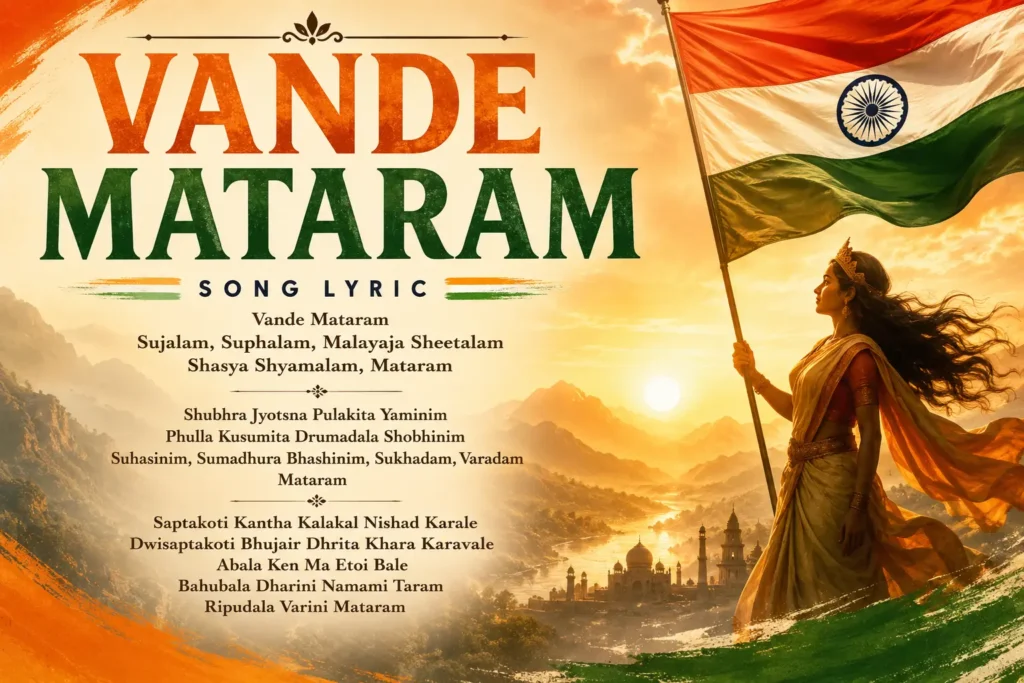
वन्दे मातरम्।
सुजलां सुफलां मलयजशीतलाम्
शस्यश्यामलां मातरम्।
शुभ्रज्योत्स्नापुलकितयामिनीं
फुल्लकुसुमितद्रुमदलशोभिनीं
सुहासिनीं सुमधुर भाषिणीं
सुखदां वरदां मातरम्॥
कोटि-कोटि-कण्ठ-कल-कल-निनाद-कराले
कोटि-कोटि-भुजैर्धृत-खरकरवाले,
अबला केन मा एत बले।
बहुबलधारिणीं नमामि तारिणीं
रिपुदलवारिणीं मातरम्॥
English Transliteration
Vande Mataram!
Sujalam, suphalam, malayaja shitalam,
Shasyashyamalam, Mataram!
Shubhra jyotsna pulakita yaminim,
Phulla kusumita drumadala shobhinim,
Suhasinim sumadhura bhashinim,
Sukhadam varadam, Mataram!
Koti-koti-kantha-kalakala-ninada-karale,
Koti-koti-bhujair dhrta-khara-karavale,
Abala keno ma eto bole.
Bahubaladharinim namami tarinim,
Ripudalavarinim Mataram!
Frequently Asked Questions (FAQs)
1. What is the exact meaning of Vande Mataram?
It literally translates to “I bow to thee, Mother” or “I praise thee, Mother.” It is an expression of ultimate reverence for the motherland, elevating the nation to the status of a divine, nurturing mother.
2. Who wrote this song?
The song was written by Bankim Chandra Chattopadhyay, a prominent Indian author, in the 1870s.
3. Which book or movie is it from?
It was first published as part of Bankim Chandra’s famous socio-political Bengali novel Anandamath in 1882.
4. What language is Vande Mataram written in?
The first two verses (which are designated as the National Song) are written entirely in Sanskrit, while the later verses in the novel seamlessly mix Sanskrit and Bengali.
5. Who was the first person to sing it publicly?
Nobel Laureate Rabindranath Tagore was the first person to sing it in a political context during the 1896 session of the Indian National Congress.
6. Why was it banned?
The British colonial government banned the song and the slogan because it became a powerful rallying cry for revolutionary groups and incited widespread anti-colonial sentiment.
7. Is it the National Anthem of India?
No, “Jana Gana Mana” is the National Anthem. However, “Vande Mataram” holds the official status of the National Song of India, enjoying an equal status to the anthem.
8. What is the difference between the National Anthem and the National Song?
The Anthem (“Jana Gana Mana”) is a formal protocol song representing the state, while the National Song (“Vande Mataram”) represents the historical, spiritual, and emotional struggle for freedom.
9. Who translated the song into English?
Sri Aurobindo Ghosh, a prominent philosopher and nationalist, provided the most famous and widely accepted English translation of the song.
10. Why is the song popular among the youth today?
Modern renditions, especially A.R. Rahman’s 1997 studio album “Vande Mataram,” infused modern beats and high-energy vocals, making it incredibly popular among younger generations.
11. What does “Sujalam Suphalam” mean?
It translates to “rich with waters, rich with fruits.” It highlights the agricultural wealth and the life-sustaining natural resources of the Indian subcontinent.
12. When was it adopted as the National Song?
The Constituent Assembly of India adopted the first two verses of “Vande Mataram” as the National Song on January 24, 1950.
10 Interesting & Unknown Facts
- The song was composed in 1876, nearly six years before it was published in the novel Anandamath.
- Lala Lajpat Rai started a prominent journal named Vande Mataram from Lahore.
- Bhikaji Cama created the first version of the Indian national flag in 1907 in Germany, which had “Vande Mataram” inscribed in the center.
- The British passed laws making it a crime to shout the slogan “Vande Mataram” in public gatherings.
- Matangini Hazra, a 73-year-old female revolutionary, died chanting “Vande Mataram” as she was shot by the British police in 1942.
- In a 2002 international poll conducted by the BBC World Service, “Vande Mataram” was voted as the 2nd most popular song of all time from a staggering 7000 songs.
- The melody of the song is based on Raga Desh, a classical Indian musical scale associated with patriotism and rain.
- Subhas Chandra Bose utilized the emotional power of the song to rally troops for the Indian National Army (INA).
- A.R. Rahman’s version of the song holds the Guinness World Record for the most languages performed in a single album tribute.
- It remains one of the few songs globally that effectively shifted the paradigm of a political revolution by defining the nation as a spiritual Mother Goddess.
Conclusion: Beyond the Lyrics
Reading the lyrics of “Vande Mataram“ is merely scratching the surface of an immense historical iceberg. To truly understand this masterpiece, one must feel the heartbeat of 19th-century India. It is a song that transformed timid citizens into fearless revolutionaries. It taught a fractured society that their true wealth was not in gold, but in their rivers, their crops, and their unity.
As music lovers and readers, we encourage you not just to memorize the words, but to absorb the Song Explanation and its profound Life Lessons. Whether you read the English Meaning, the Hindi Meaning (हिन्दी अर्थ), the বাংলা অর্থ, or the தமிழ் பொருள், the core message remains universally potent: Honor the earth that feeds you, stand united in the face of adversity, and find divine strength within your collective identity.
The next time you hear the grand chorus of “Vande Mataram,” remember the millions of voices from history singing right beside you. Thank you for exploring the soul of this immortal anthem with us.
About This Article
| Reviewed By | Music Research Team |
|---|---|
| Content Type | Song Meaning, Translation, Background & Educational Analysis |
| Published | May 10, 2026 |
| Last Updated | July 22, 2026 |
| Reading Time | 11 min read |
| Article Purpose | Provide educational analysis, song meaning, translation, artist information, and verified music facts. |
Sources
This article has been prepared using publicly available music information and reliable editorial references. Song details, artist information, and album metadata have been verified using the following official and trusted sources whenever available.
- Official Artist Website
- Official Record Label
- Spotify
- Apple Music
- YouTube Music
- MusicBrainz
- Discogs
- AllMusic
- IMDb (where applicable)
Copyright Notice
Copyright Disclaimer & DMCA Notice:
Song lyrics are protected by copyright law and are the exclusive property of their respective owners. The lyrics and translations provided on this website are published for educational, commentary, research, and informational purposes only.
Notice to Copyright Holders:If you are a copyright owner or an authorized agent and believe that any content on this website infringes upon your copyrights, please contact us at info@songsubtext.com.
We respect intellectual property rights and will promptly remove any infringing material upon valid request.
Editorial Policy
Our editorial team researches every article using reliable music databases, official artist information, album credits, and trusted industry resources. Every page is reviewed for originality, accuracy, and compliance with copyright regulations.